
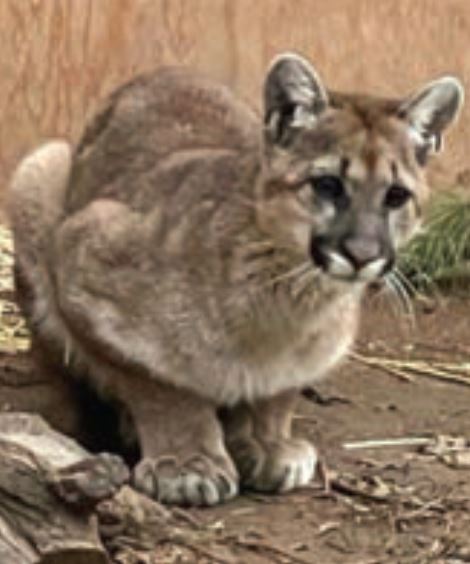
A young mountain lion struck by a vehicle earlier this year has been successfully rehabilitated and released back into the wild, according to the San Diego Humane Society.
The male mountain lion, estimated to be 10 months old, was released June 17 by the California Department of Fish and Wildfire into a remote area of the Santa Ana Mountains in Orange County after spending nearly five months recovering at the Ramona Wildfire Center.
The animal was transferred to the center on Jan. 15, four days after the collision. He had received emergency care at Serrano Animal and Bird Hospital in Orange County for a skull fracture, head and eye trauma, and a limp in his left hind leg.
During the early stages of recovery, the San Diego Humane Society’s Project Wildlife team focused on pain management, nutritional support and close monitoring. Once stable, the mountain lion was moved to an outdoor enclosure to continue healing with minimal human interaction – an approach aimed at preserving natural behaviors critical for survival in the wild.
After 153 days of care, the animal had gained strength, reached a healthy weight of about 60 pounds, and demonstrated necessary survival behaviors.
“This is the moment we all work toward – seeing a wild animal return to where they belong,” said Autumn Welch, wildlife operations manager at San Diego Humane Society’s Ramona Wildlife Center. “Our job is to provide medical care while preserving the animal’s wild instincts, so they have the best possible chance at surviving on their own.”
The Ramona Wildlife Center, part of the San Diego Humane Society’s Project Wildlife program, specializes in the care of apex predators and birds of prey. Under specific authorization, it can also rehabilitate mountain lions.
The organization is currently caring for two additional orphaned mountain lion clubs who arrived March 26. The cubs, found alone, were safely trapped by the UC Davis California Carnivores Program Team and the CDFW, and transferred to the Ramona facility for rehabilitation.
Staff aim to raise the clubs in an environment that limits human contact, encouraging survival behaviors. Once the animals reach a healthy weight and demonstrate wariness of humans and independent hunting skills, they may also be released.
“We’re grateful for our partnership with CDFW and UC Davis, and for the opportunity to give these incredible animals a second chance at life in the wild,” Welch said.
Project Wildlife cared for more than 10,000 wild animals each year, from orphaned birds to apex predators, with the goal of rehabilitating and returning them to their natural environments.