


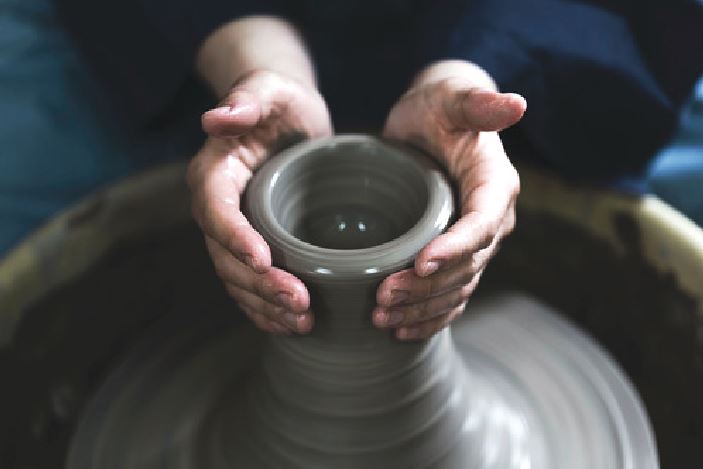
The kilns are fired up again at Grossmont College as the Hyde Art Gallery features VIEWPOINT: Ceramics 2026, a dynamic revival of a juried exhibition series that has shaped the region’s ceramics conversation since 1977.
For Gallery Director Alex DeCosta, bringing VIEWPOINT back is both a nod to history and a bold step forward.
“VIEWPOINT: Ceramics has been on my mind since I assumed the directorship of the Hyde Art Gallery in 2016,” DeCosta said. “At one time, the Grossmont College Art Gallery presented the premier Southern California survey of contemporary ceramics. It is my hope that this exhibition helps regenerate interest in what is both a historically significant and deeply communal medium.”
That sense of community is central to this year’s exhibition — and to ceramics itself.
“In the wake of the pandemic, which fostered a profound sense of isolation within our communities, ceramics feels especially resonant,” DeCosta said. “It is inherently collaborative — requiring collective effort to source and mix materials, maintain and operate kilns and equipment, move large-scale works, and ultimately ship, curate, and install them. Ceramic artists depend on the community to sustain their practice.”
Despite broader cultural pessimism, he noted, artists continue to experiment and expand the possibilities of clay.
“Despite broader cultural pessimism, they continue to thrive, experiment, and push the medium forward through innovative techniques and materials,” De- Costa said.
While ceramics have long been associated with functional pottery, VIEWPOINT: Ceramics 2026 makes clear that the field has evolved far beyond utilitarian vessel-making.
“Contemporary ceramics has long since moved beyond utilitarian vessel-making,” DeCosta said. “Today’s artists engage expansive conceptual and sculptural approaches, often integrating other media into their work.”
In this exhibition, artists apply acrylic and oil pastel directly onto clay surfaces, experiment with photographic processes such as cyanotype, and incorporate ceramics into larger assemblage and installationbased practices. The result is a show that feels both grounded in tradition and boldly forward-looking.
As an academic gallery, the Hyde Art Gallery occupies a unique place in San Diego County’s arts landscape. In a region without the density of commercial galleries found in Los Angeles or New York, community college galleries play an essential role in presenting ambitious exhibitions.
“In San Diego, a city without the density of commercial galleries found in Los Angeles or New York, community college galleries play a vital role in providing ambitious exhibition programming,” DeCosta said.
“The work on view serves primarily as an educational resource, enriching our students’ artistic development and demonstrating viable professional pathways.”
The impact extends far beyond the gallery walls. Exhibitions are frequently engaged across disciplines, inspiring writing assignments, choreographic improvisation, acting monologues, and discussions in Earth Sciences, Humanities, and Philosophy.
“More broadly, I believe art practices, including ceramics, benefit from cross-disciplinary engagement,” DeCosta said. “As presentation increasingly shifts to digital platforms, artists must build community across mediums and audiences. Exhibitions like this foster those intersections while maintaining the tactile, communal foundation that defines ceramics.”
The exhibit closes March 4.
The Hyde Art Gallery is open Monday through Thursday from 10 a.m. to 4 p.m., closed weekends and holidays. Visitors must purchase a $2 daily parking permit via QR codes in campus lots. For more information, contact Alex DeCosta at alex.decosta@gcccd.edu or (619) 644-7214, or visit www.hydeartgallery.com.