


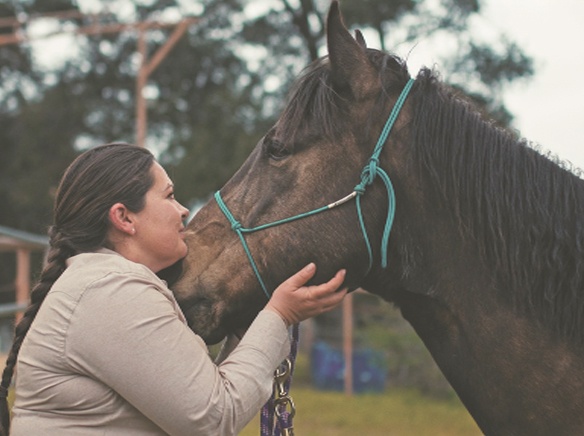
In a quiet corner of East County, a veteran-founded nonprofit is offering a different path to healing for those struggling after military and first responder service—through horses, community, and connection.
Saddles in Service, a 501(c)(3) based in Alpine, provides equine-assisted healing at no cost to veterans, active-duty military, and first responders dealing with PTSD, anxiety, depression, job-related stress, or traumatic brain injuries.
Founded in 2017 by Tammy and Mike Oluvic and Jill Breen, the program has drawn increased attention as national conversations around veterans’ mental health expand, including renewed interest in psychedelic therapies. But leaders say the need for immediate, accessible care is already urgent.
“Many of the people who protect our country and communities carry invisible wounds of service, including PTSD, depression, and suicidal thoughts,” said David Perloff, vice president of marketing and community relations for Saddles in Service. “Saddles in Service helps save lives by giving these heroes a path to rebuild trust, purpose, and connection.”
The organization reports that 1,171 participants served, 9,376 sessions conducted, and a 92 percent reduction in anxiety and depression, reaching more than 4,000 individuals, including family members.
For co-founder Tammy Oluvic, the program began with two rescued horses and a turning point at home.
The couple had recently moved to a small property in Alpine, where Oluvic adopted two horses. What happened next changed everything.
“We saw how they helped my husband,” she said. “He has PTSD, agoraphobia, depression, and anxiety, and I saw how the horses helped him regulate his anger. It was amazing.”
Mike Oluvic, a retired U.S. Navy veteran of 24 years, had long wanted to work with horses after military service.
“And I was like, ‘Oh, we have to do this,’” she said. “We have to get other people out here. And that’s how it started.”
The first participant arrived in December 2017.
“He’s like, you know, we’re not ready,” Tammy Oluvic said. “And I go, yes, my team knows we’re not ready. But his sister begged me to have him come out.”
That Army veteran, Joe Kevardis, had served in Afghanistan in the same regions as Mike.
“They hit it off right away,” she said. “At the end, Mike goes, ‘Hey Joe, we’re not ready—but do you want to help us get ready?’ And Joe was our first hero.”
The program follows a structured, yearlong progression built around trust, awareness, and responsibility.
“We start with the predator-prey relationship,” Tammy Oluvic said. “The horse mirrors what they are putting out—energy, body language. The first thing they realize is the horse is showing them what they’re carrying.”
That awareness often becomes a turning point.
“It helps them release. They feel like, ‘I can breathe. I can just be who I am.’ The horse isn’t judging them.”
Participants progress through groundwork, riding, and cattle work, eventually completing a weeklong cattle drive in Wyoming’s Bighorn Mountains.
“A lot of them come multiple times a week because they want to be around the horses,” she said. “That’s where they feel good.”
Many later return as mentors.
“They become the wranglers,” she said. “It’s a full circle.”
Tammy Oluvic said one of the biggest misconceptions is that equine-assisted work must mirror traditional clinical therapy.
“When they’re with the horses, they can’t feel like they’re being analyzed,” she said. “They can’t just be themselves.”
She said traditional therapy still has value, but the setting matters.
“With horses, it’s holistic. You’re in nature. We’ve had Delta Force and Green Berets come here. They wouldn’t come if it felt clinical.”
Perloff said success is measured in long-term stability and reconnection.
“Success is when a hero who came in struggling with trauma, isolation, or suicidal thoughts leaves with stability, connection, and purpose—and carries that forward into their life, family, and community,” he said.
For Tammy Oluvic, the most lasting change is often the community itself.
“So many of them don’t have community when they leave the military or first responder roles,” she said. “Here, they have it again.”
And the impact extends beyond the individual.
“It’s not only the hero,” she said. “It helps their families, too. It’s like a domino effect.”
Perloff said demand continues to grow.
“There is a growing waitlist,” he said. “Funding limits access. The program is free, but it takes horses, land, and staff.”
A $25 donation feeds a horse for a day, while a $7,500 donation sponsors a full participant’s healing journey through the program.
For the Oluvics, the mission remains deeply personal.
“This is about getting people back to themselves,” Tammy Oluvic said. “The horses do that. We just create the space for it.”