


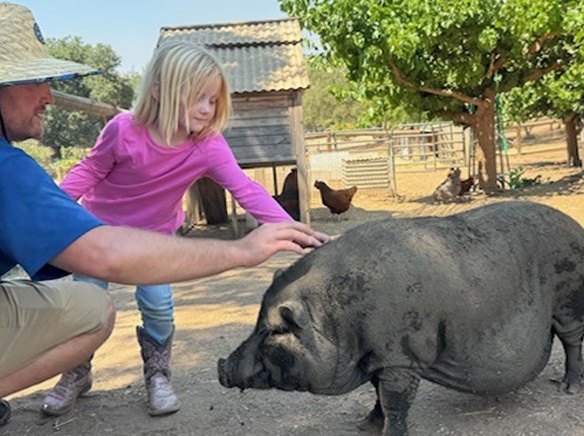
Alpine Acres Sanctuary Farm is appealing to the community for emergency support as it faces critical financial challenges that threaten its operations. Founder and Executive Director Agnes Barrelet says the sanctuary, home to nearly 200 rescued animals, urgently needs funds to cover staff payroll, essential water system repairs, veterinary care, and equipment maintenance.
Barrelet, who lives on-site, oversees daily care for the sanctuary’s residents, including feeding, administering medication, monitoring enclosures, and coordinating staff and volunteers.
“Living here means I can monitor the animals throughout the day and evening, which is invaluable for their safety and well-being,” she said.
The sanctuary’s current expenses include $16,730 for staff payroll, $11,387.50 to repair a critical well and pipe system, $3,520.90 for veterinary emergency visits and end-of-life care, and $1,664.57 for golf cart repairs used in daily operations. To operate without extraordinary expenses, the farm needs to raise $55,000.00 per month. Barrelet said that without immediate funds, operations and animal welfare could be compromised.
A trademark dispute with Lions Tigers & Bears animal sanctuary contributed to the financial difficulties, Barrelet said.
A settlement payment due Aug. 3 was withheld because of delays in completing required name changes on Google, which were caused by Google suspending the sanctuary’s account after a trademark complaint.
After the account was reinstated Aug. 25 Alpine Acres Sanctuary Farm received the settlement payment Sept. 4. But the delayed payment created financial strain, Barrelet said.
Lions Tigers & Bears Founder Bobbi Brink issued a statement: “Lions Tigers & Bears is the only nationally accredited true rescue exotic animal sanctuary here in San Diego. This accreditation is important because it requires a peer review from the most prestigious organizations committed to animal welfare. This matter has been settled, and we are unable to comment.”
The recent heat wave also worsened the crisis, keeping visitors away and reducing the sanctuary’s primary source of revenue. Barrelet noted that during extreme temperatures, visitor numbers decline while operational costs rise due to increased water and electricity usage for animal care.
She shared examples of individual animals requiring specialized care. Little, a dwarf horse with Cushing’s disease, needs a specific pellet diet and supplements; Aiden, a mini horse with seizures, takes 11 pills twice daily; and Pearl, a Friesian horse, receives monthly allergy injections and medicated baths. Barrelet highlighted Willow and Basil, two Nubian goats rescued as abandoned infants, now thriving under the sanctuary’s care.
Volunteers assist with tasks such as cleaning enclosures and supporting visitor operations, while trained staff manage direct animal care. Barrelet emphasized that animal welfare is prioritized when making operational decisions.
Barrelet said the sanctuary is pursuing long-term strategies for sustainability, including corporate sponsorships, farmers’ markets, educational programs, and agritourism, but immediate community support is essential. “With 13,000 people on our email list, if everyone contributed just $10, we’d be completely stable,” she said.
Donations are tax-deductible and can be made online at sanctuaryandfarm. org, by phone at (619) 320-4942, or by mail to Alpine Acres Sanctuary Farm, 5178 Japatul Spur, Alpine, CA 91901.