


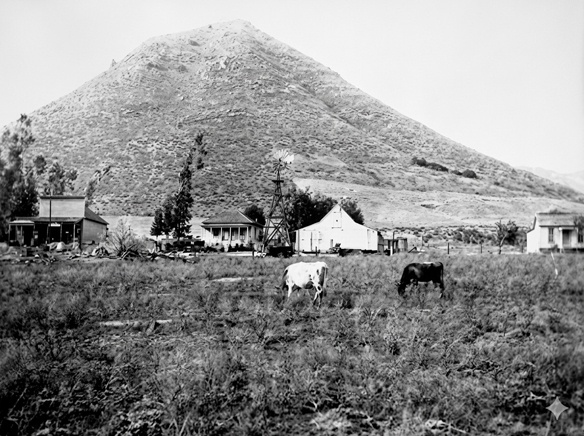
Alpine sits in a corridor that has been occupied for thousands of years before European contact. The earliest known residents of the area were the Kumeyaay people, who lived across much of present-day San Diego County long before European arrival. Archaeological and ethnographic records document long-term use of the region’s seasonal resources, including native plants and water sources in the surrounding canyons and foothills.
That Indigenous presence is not only historical but ongoing. Alpine remains within Kumeyaay ancestral territory, and nearby tribal governments, including Viejas and Sycuan, continue to maintain cultural, governmental, and land-based presence in East County today.
Spanish expeditions passed through inland San Diego County in the late 18th century, followed by Mexican-era land grants and later American settlement in the 19th century. The name “Alpine” appears in late 19th-century accounts and is generally believed to reflect early settlers’ impressions of the surrounding mountainous terrain, likened to European alpine regions. That naming pattern reflected a broader trend in California during the period, when new settlements were often described using familiar European references.
One of the more documented early industries tied to the broader Alpine region was commercial beekeeping. In the 1870s, John Stewart Harbison established large-scale apiary operations in nearby Harbison Canyon, just east of Alpine. His enterprise became among the largest honey-producing operations in the United States at the time, shipping product to national markets.
Harbison’s operation was not a small local venture. It helped establish Southern California as a major center of commercial honey production in the late 19th century, with the region’s chaparral and native flowering plants supporting large-scale apiaries capable of sustained production and long-distance shipping.
For much of its early development, Alpine remained a small rural settlement connected by wagon routes and later highway systems. Growth remained limited until the expansion of regional transportation corridors in the 20th century, including U.S. Route 80, which improved access between inland communities and the coast.
The completion of Interstate 8 in 1969 marked a major turning point. The freeway created a direct transportation link between San Diego and the Imperial Valley, reducing travel time and increasing residential development pressure in communities like Alpine. Over time, that access helped transform the area from a rural stopover point into a foothill residential community tied to regional commuting patterns.
Despite that growth, Alpine still retains a lower-density landscape shaped by surrounding open space, canyons, and mountain terrain. Its modern identity sits between suburban expansion and preserved foothill geography, with land use still shaped by the natural contours of the region.
Today, Alpine reflects multiple overlapping layers of history: Kumeyaay presence stretching back thousands of years, 19th-century agricultural innovation through commercial beekeeping, and mid-20th-century transportation-driven suburban expansion. What appears now as a quiet East County community sits within a much longer timeline of settlement, adaptation, and change.