


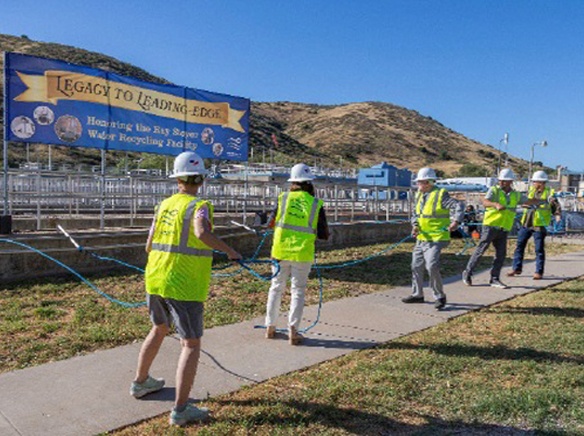
The Ray Stoyer Water Recycling Facility was officially decommissioned on April 8 marking more than 50 years of service in East San Diego County and closing a significant chapter in the region’s water recycling history.
Over its decades of operation, the facility played a central role in regional water management, helping address water supply challenges, supporting wastewater treatment and recycling efforts, and contributing to recreational uses at Santee Lakes.
It also served as an early and long-running example of sustainable water reuse in East County, based on the principle that water is too valuable to be used only once.
The facility is named after Ray Stoyer, former general manager of the Santee County Water District, who helped advance early water recycling efforts that later evolved into a widely recognized regional system of reuse and innovation.
The facility was commissioned at its site just north of Santee Lakes in 1967 and operated continuously for decades. A major expansion completed in 1997 increased its capacity, allowing it to produce up to two million gallons of recycled water per day. That water supported Santee Lakes as well as other non-potable applications throughout the surrounding community.
“The Ray Stoyer Water Recycling Facility has been a cornerstone of water sustainability in East County for more than half a century,” said Kyle Swanson, general manager and CEO of Padre Dam Municipal Water District. “Its legacy of innovation has set the standard for responsible water reuse. While we honor this incredible facility, we are excited to continue its pioneering spirit with the East County Advanced Water Purification Program, providing reliable drinking water for our community for generations to come.”
The transition to the East County Advanced Water Purification Program represents the next phase of water infrastructure development in the region, focused on creating a local, sustainable, and drought-resilient drinking water supply through advanced purification technology.
Once fully operational, the program is expected to treat up to 16 million gallons of wastewater per day and produce approximately 11.5 million gallons of purified water daily, helping offset a significant portion of imported water demand in East San Diego County. The project is among California’s early advanced water purification efforts focused on potable reuse and water supply diversification.
“The Ray Stoyer Water Recycling Facility has always been more than a workplace,” said Rob Northcote, operations manager for the East County AWP Program, who began his career at the facility in 1997. “I’ve been honored to be part of a facility distinguished by its history, innovation, and depth of expertise. It’s incredibly rewarding to see its legacy continue, as the dedication of those who worked here will help guide the East County AWP Program into the future.”
The decommissioning was marked by a symbolic moment when Padre Dam Municipal Water District’s Board of Directors participated in a ceremonial action at the facility’s aeration basin, signaling the official end of operations.
Padre Dam Municipal Water District provides water, sewer, recycled water, and recreation services to more than 100,000 residents across East San Diego County, including Santee, El Cajon, Lakeside, Flinn Springs, Harbison Canyon, Blossom Valley, Alpine, Dehesa, and Crest.