


On any given day in the backcountry of San Diego County, volunteers can be found washing dishes, preparing animal diets, greeting guests, or quietly brushing a rescued horse.
At both Alpine Acres Sanctuary Farm and Lions Tigers and Bears, their work is constant — and essential.
April is recognized as National Volunteer Month, highlighting the role volunteers play in communities — a contribution seen daily at both sanctuaries, including Lions Tigers and Bears, Southern California’s only accredited big cat and bear sanctuary.
Behind the scenes, volunteers form the backbone of daily operations, contributing thousands of hours each year to care for rescued animals and support each organization’s mission.
At Alpine Acres, volunteer Eileen Logue has seen the sanctuary evolve firsthand.
“I was impressed by the work both locally and in Africa that the foundation was doing and decided to help,” Logue said.
She watched the sanctuary grow from an idea into a working refuge.
“It was exciting to see the development of the animal sanctuary, and seeing the first animals arrive was a thrill.”
Today, she serves as a guest services ambassador.
“I help process guests at the front desk as well as direct guests — a goodwill ambassador of sorts,” she said.
For Linda Kourtis, volunteering began with a recommendation.
“I had initially planned to volunteer at Lions, Tigers and Bears, until a friend … suggested Alpine Acres,” she said.
She has now been volunteering there for 3 years.
“When I started 3 years ago, I did mucking and brushing some of the horses,” Kourtis said. “Due to health issues, I was encouraged to brush and massage the horses and donkeys.”
The work has created lasting connections.
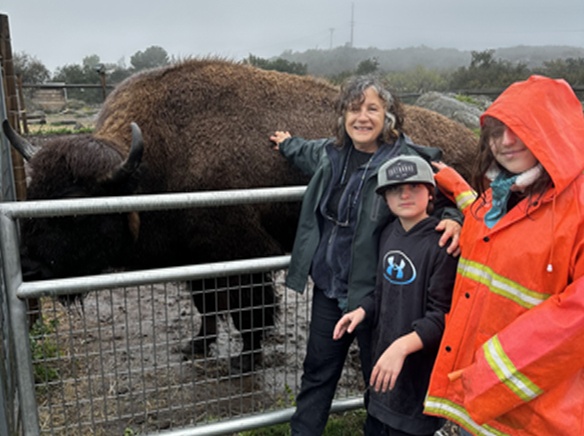
“When I first met Cheyenne the bison, I was smitten. His big brown eyes and gentle nature were a magical experience.”
Both volunteers said the experience has deepened their understanding of animal care.
“I have a new appreciation for the amount of care and intention that goes into caring for animals,” Logue said. “It is an awesome responsibility and a privilege.”
Kourtis has also experienced the emotional realities of sanctuary life.
“Two of my favorite animals … both seniors passed on,” she said. “What made it easier was to know they had lived a life after their rescue where they had top-notch care and love.”
At Lions Tigers and Bears, volunteers often begin as visitors.
Lynn Chavez, who has volunteered for 5 years, said her connection started more than a decade ago.
“Our family first visited LTB 12 years ago, and we fell in love with the sanctuary,” she said.
At first, she assumed experience was required.
“That’s when I realized volunteers didn’t need prior experience with exotic animals,” she said.
Her first day reflected the reality of the work.
“I washed dishes, a lot of dishes!”
Today, her responsibilities include a wide range of duties.
“My day-to-day volunteer duties can include administering medications, preparing and feeding diets for some of the exotic animals … and washing dishes. Always washing dishes!”
She also recalled a memorable moment with a rescued black bear.
“When she heard me, she raised her head, looked toward me, and ran down the hill. I realized then that she knew my voice.”
Another longtime volunteer, Carolyn Gobler, said her involvement grew after years of visiting.
“I started volunteering once a week, and then it morphed into two days weekly,” she said.
Her work includes guiding educational visits and helping prepare food for animals: “We are all taught to make peanut butter and jelly sandwiches for the bears … cut up fruits and veggies … or cut up meat for feeding the cats.”
For Gobler, the animals’ comfort is the clearest sign of success.
“I love it when we come upon an animal, and they are lying on their back … This tells me we are giving them a safe, comfortable place to live out the rest of their lives,” Gobler said.
Work that never stopsVolunteers at both sanctuaries say the work is constant.
“It is never-ending,” Logue said. “There is no downtime or no time off … It is the shift that never ends.”
At Lions Tigers and Bears, the scale of volunteer support is significant.
“Last year, volunteers logged over 30,000 hours,” Chavez said. “The sanctuary … depends on the dedication of the volunteers.”
More than giving backDespite the demands, volunteers say the experience is deeply rewarding, often in ways they didn’t expect. Logue reflected that “I receive more than I give,” adding that through her time at the sanctuary, “I have a sense of purpose.”
Others describe a quieter, more personal impact. Kourtis said, “Volunteering with the animals has taught me to be in the moment,” while Logue noted that simply being outdoors has made a difference, saying, “I find that being in nature … has nourished me.”